The chapel in the woods
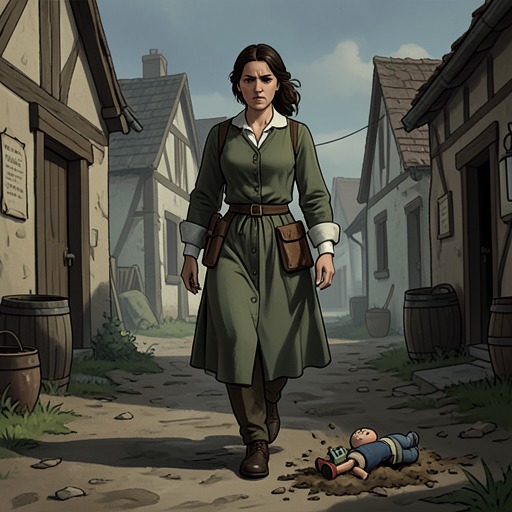
Down Cemetery RoadThe chapel in the woods is a remote, unmarked building whose history as a hiding place draws Sarah Trafford to it and whose empty interior brings her face to face with Michael Downey and Dinah. The refuge that once sheltered Michael and Tommy Singleton becomes, in Sarah’s present, the enclosed setting for a confrontation in which past violence returns and several armed characters converge.
Setting and Approach
The building stands apart from any clearly named place. Sarah can see no name on the chapel and nothing that would tell her where she is. Its small wooden door is very old, but the wood around the handle is freshly splintered; iron nails are stamped into it like bullets. Bushes claw out of the stony ground around the entrance, an image that makes the approach seem both exposed and difficult to enter. The setting offers signs and impressions, not an identifying landmark or a reassuring welcome.
A stained-glass window depicts what Sarah sees as a somewhat Celtic cross. Behind the building, a blue 2CV is parked lopsided, its rear left wheel lifted about an inch above the ground, as though its front right wheel has found a ditch. These details establish an uneven, provisional arrival: the car is not neatly settled, and the entrance bears fresh damage despite the door’s age. The chapel appears old and isolated, but the scene around it is not untouched or still.
A Remembered Hiding Place
Sarah’s reason for recognizing the chapel is a memory of what Michael had said about it. He and Tommy Singleton hid there after escaping. The recollection gives the otherwise unidentified building a specific place in their history: it was not merely a landmark mentioned in passing but a refuge used during flight. Sarah has remembered that Michael talked about it, although the immediate evidence does not establish that he had arranged to meet her there.
Zoë Boehm understands the implication of Sarah’s recollection and calls the place spooky before reaching into her bag for her gun. Sarah, absorbed in the memory, does not notice. She takes the few steps to the door and pushes it open. The movement from remembering to entering is swift, but the chapel’s earlier use as a hiding place cannot guarantee safety now. Its meaning has changed with the people who occupy it and the danger Sarah has brought to its threshold.
Interior and Encounter
Inside, the chapel has no benches, altar, or furniture of any kind. It is a bare room with a filthy stone floor, old cracked windows, and naked beams low overhead. This lack of furnishings leaves the people in the room unusually exposed against the architecture: there is no domestic arrangement or ceremonial activity to soften the scene, only stone, beams, and bodies.
Sarah’s first association is with the chapel at Arimathea, where she had earlier gone looking for Dinah. The likeness in the buildings triggers a rush of memories: a house collapsing, a man bleeding at his desk, the attempt to kill her with dental floss, and her own fall from a roof years before. Those flashes gather in the present chapel, where Sarah is again searching for a girl who has survived. The place works as a physical setting and as a point of return for memories of danger; the narrative makes Sarah’s arrival feel like another turn in a succession of ordeals rather than a clean escape from them.
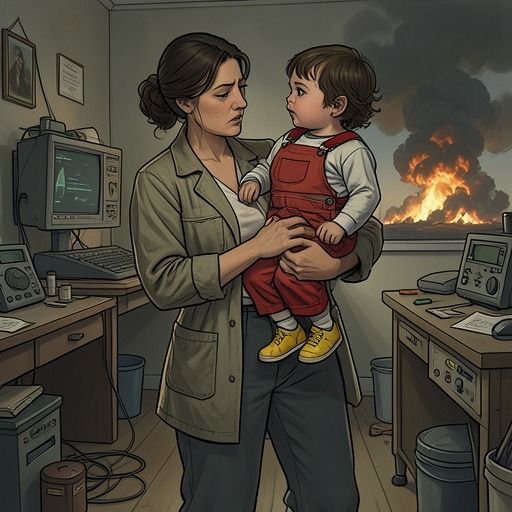
Against the wall opposite the entrance, Michael sits holding Dinah. He levels a gun at Sarah as she steps out of the shadow. He lowers it, raises it again when he sees Zoë behind her, and then puts it down once more. The changes in the weapon’s position mark the arrival of each woman as a separate threat or recognition, while Michael’s exhaustion is visible to Sarah. The chapel’s former role as a place where he and Tommy hid is now set against this tense meeting with Sarah and the child she has been seeking.
Convergence and Significance
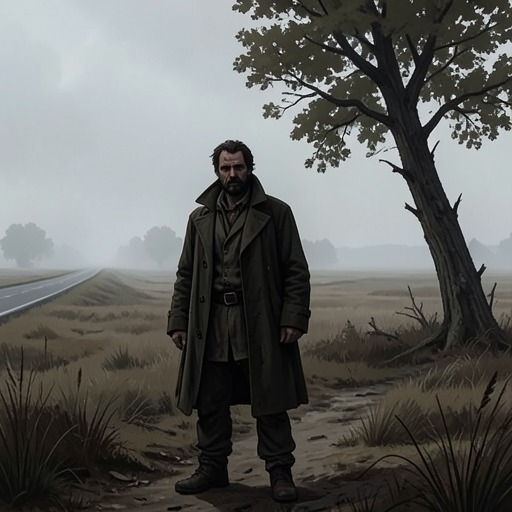
The chapel does not remain a private refuge. Amos Crane comes walking down the track, and the encounter that Sarah has feared becomes a gathering in the cold, empty room. David Keller is also present, dead after Amos killed him and took his identity and car. Amos approaches and crouches with the others, smiling; Sarah recognizes in that smile the history of Rufus, or Axel, and the attack that nearly killed her in her kitchen. The chapel thus brings the earlier violence of Sarah’s life into direct contact with its present danger.
As Sarah understands the return of the past, she thinks, “Everything stops where it started.” The thought belongs to the chapel’s particular geography as well as to her recollection: the refuge connected to Michael and Tommy’s escape is now the place where flight, recognition, and threatened violence meet again. Zoë reaches for her gun, but it is already in Amos’s hand. Michael reaches for his own, while Zoë’s little pistol presses against Sarah’s ear. The evidence ends with the room held in that armed impasse, making the chapel not a sanctuary from the story’s conflicts but the enclosed stage on which they converge.